Building a better future for all of us.
A different approach
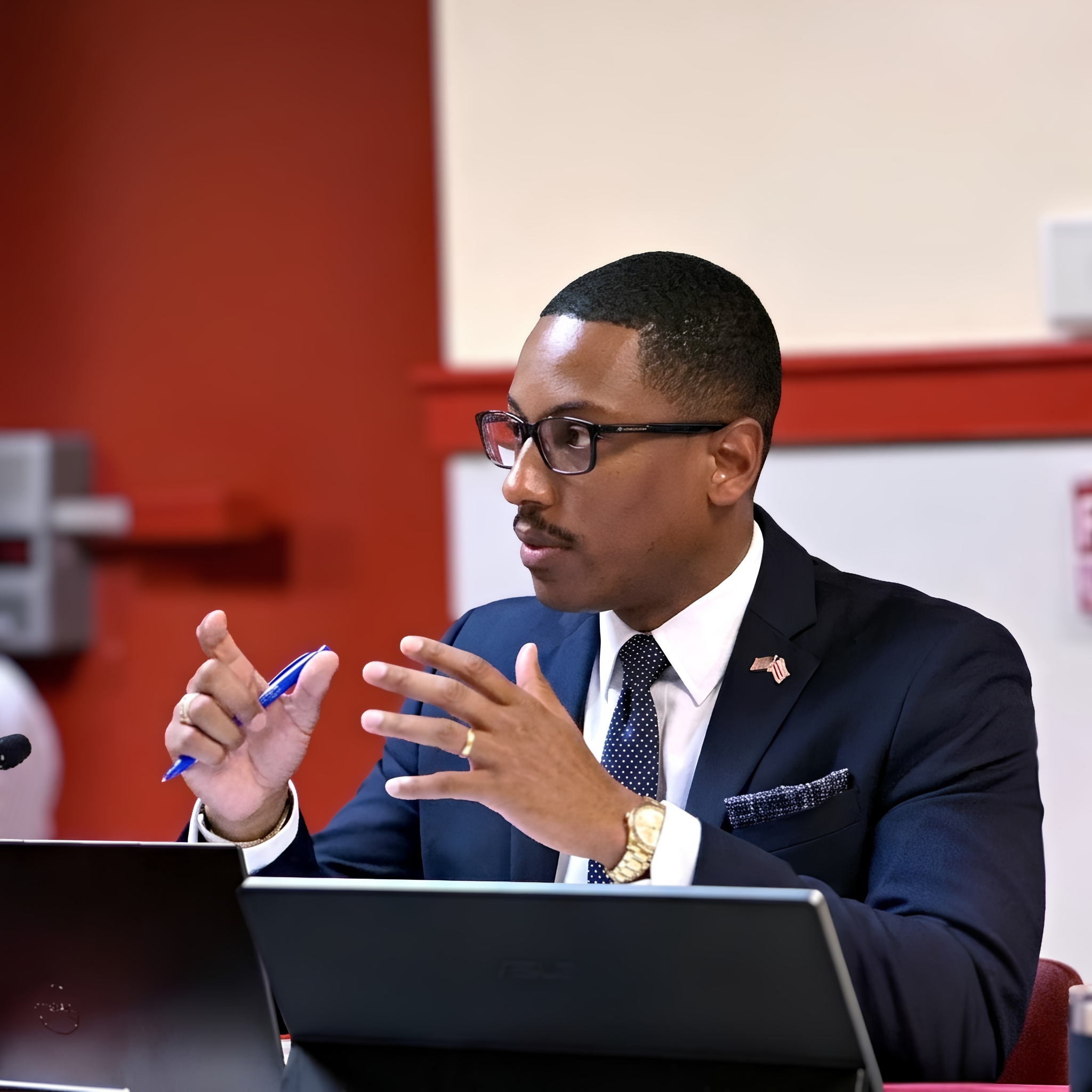
Anthony Thomas-Davis doesn't just talk about Columbia Heights — he consistently shows up for the neighborhood and fights for it. Across two terms, Anthony has turned residents' concerns and priorities into solutions-oriented action, from moving the 11th & Bark dog park forward to crafting neighborhood safety and beautification plans to holding agencies and community-based organizations accountable for how they serve our neighborhood. He'll keep listening, keep pushing, and keep delivering for 1A06 and all of Columbia Heights. Anthony will cut through the noise to solve problems and turn your concerns, hopes, and aspirations for you, your family, and the neighborhood into real action and results.
Anthony is running for re-election as the Commissioner for ANC 1A06 because he deeply believes in the endless possibilities for Columbia Heights and knows its best days are still ahead. Anthony is passionate about public service and shows up for you and your neighbors every time— not just when it counts or when people are watching—and that won’t change. Anthony is a fighter who will stay focused on your priorities and the challenges and opportunities to make a meaningful difference for Columbia Heights and the District. Anthony brings a very different approach and a new kind of politics to this position, one that always puts residents’ interests first, fights for safer communities, improved city services, a government that works, and a stronger, brighter future for Columbia Heights.
Read more →
“My fight for progress with purpose extends beyond short-term fixes; it encompasses sustainable solutions that lay the foundation for greater opportunity for all of Columbia Heights.”
My vision for our community
Progress demands innovation and adaptability. By embracing new, big, and bold ideas, championing sustainable solutions, and fostering a climate of inclusivity and collaboration, Anthony will always foster an environment that empowers every Columbia Heights resident, family, and small business to thrive. Anthony didn’t run to be your Commissioner to respond to problems or issues, but to build a stronger, brighter future for our neighborhood, together.
Big, Bold Ideas,
Real Impact.
Driven by an unrelenting curiosity and focused on purposeful progress and problem-solving, Anthony has matched bold thinking with deliberate action that gets results. His record proves that he is more than ready to keep fighting for you and your neighbors.
-
As the 1A06 Commissioner, Anthony has approached public safety not as a single-issue concern but as a system-level challenge that requires coordination among agencies, community stakeholders, and the Commission itself. His comprehensive neighborhood safety resolution (R25-0045, “A Resolution Concerning Policing, Security, and Neighborhood Safety in Columbia Heights”) was among the most detailed public safety policy recommendations ever produced by ANC 1A, laying out specific recommendations for policing, community-based violence intervention, and inter-agency accountability. Rather than simply calling for more enforcement, the resolution demanded that the District treat Columbia Heights as a neighborhood deserving of coordinated, sustained attention—not a police service area to simply be managed from one incident to the next.
Taken together, the policy measures that Anthony has introduced and gotten passed at ANC 1A reflect a consistent and clear philosophy: residents themselves must have meaningful input into how community safety resources are allocated, how programs are evaluated, and how police show up and perform on our blocks. And while we can’t fully dictate the latter, Anthony has engaged deeply with MPD to build rapport that has translated into a different approach in the Third District. The resolution on community safety program input (R26-0023, “A Resolution Concerning Neighborhood Input for Community Safety Programs and Grant Awards in Columbia Heights and Ward 1”) formalized that principle, insisting that grant awards and safety programming in Ward 1 be shaped by the people they are meant to serve. Tangentially, Anthony’s leadership established the Special Committee on Public Life (CR10-2023, “Establishment of Special Committee on Public Life”), which created an institutional home within ANC 1A for sustained attention to quality-of-life conditions that drive perceptions of safety—from cleanliness to programming and stewardship of shared public spaces, work that has led to increased attention to many areas of the neighborhood, including Civic Plaza. That committee has become a permanent special committee of the Commission, leading foundational work to improve public realm outcomes that will have a measurable effect on overall community safety.
-
Columbia Heights’ commercial corridors have faced years of vacancy, disinvestment, and resource mismanagement, as well as a regulatory environment that too often treats small brick-and-mortar businesses as afterthoughts. Anthony’s economic development work has been defined by a refusal to accept that trajectory as inevitable and a deep belief that Columbia Heights’ best days lie ahead. His consequential resolution to accelerate small business success in Columbia Heights (R25-0012, “A Resolution Concerning Accelerating Small Business Success and Local Economic Development”) called for a fundamental reorientation of the District’s local economic development strategy toward Columbia Heights, demanding that DMPED, DSLBD, and DLCP treat the neighborhood’s commercial needs as a coordinated priority rather than a patchwork of disconnected programs, including our flailing Main Street Program. A companion resolution declaring the sense of the Commission on neighborhood investment and revitalization (R25-0013, “A Resolution to Declare the Sense of the Commission Concerning Columbia Heights Investment and Revitalization”) established the ANC’s formal position that Columbia Heights deserves the same level of strategic economic planning that the District routinely extends to other commercial districts and downtown.
These broader policy statements are reinforced by measures addressing the specific, practical conditions that determine whether businesses can survive and grow. The resolution protecting small businesses along the 11th Street corridor during DDOT’s transportation improvement planning (R25-0043, “A Resolution Concerning Protecting Small Businesses Amid Ongoing Transportation Improvement Planning Along the 11th Street, N.W. Corridor”) recognized that infrastructure projects, however well-intentioned, can devastate small businesses and if construction impacts are not actively managed – or at the very least, operators are not informed so they can work around the impacts. Anthony’s record on these issues reflects a deep, unwavering understanding that economic development is built one business, one block, and one regulatory decision at a time, and small businesses succeed in an environment where the government is a partner for growth, not an obstacle. Anthony will continue to fight to ensure that small businesses have an opportunity to grow and thrive in Columbia Heights – while also asking them to be good neighbors and do their part to help move the neighborhood forward toward a stronger, brighter future.
-
Anthony has focused his work over the last several years intently on ensuring the District delivers on the basics, including getting rid of the rats. You deserve a government that works, period. The District’s government is structured in ways that make it difficult for neighborhoods like Columbia Heights to receive the sustained, coordinated attention they need from executive agencies – and for some reason, the same approach persists despite many of us knowing it doesn’t work effectively. That is why Anthony’s resolution on the coterminality of service delivery (R26-0027, “A Resolution Concerning the Coterminality of Service Delivery in the District of Columbia”) addressed one of the most deeply structural problems in DC governance—the fact that police districts, school boundaries, health service areas, and other agency jurisdictions do not align with one another or with ANC boundaries, making it nearly impossible for residents and commissioners to hold any single entity accountable for conditions on the ground. Reminder: This is half of ANC's job: continually evaluating service delivery and advising on improvements based on residents’ complaints. Anthony also secured a win on a companion resolution on service area committee clarification (R26-0028, “A Resolution Concerning Service Area Committee Clarification and Development in Ward 1 and The District of Columbia”), pushing Ward 1 toward a clearer framework for how ANCs and the communities they serve can better interact with the Executive, including regular monthly or quarterly meetings.
Anthony also examined another systemic failure that hinders ANCs’ ability to serve their constituents effectively: the timing and manner of our notice of government actions in our commission areas. Aside from a few defined categories, ANCs can be and are routinely blindsided by agency actions in our own neighborhoods because no standardized mechanism exists to alert us to actions taken by the District government. Also, when notice is received, reaching our constituents to achieve the broadest possible engagement and input can be challenging. That is why Anthony passed a measure that addresses the establishment of a District-wide early notification system (R26-0032, “A Resolution Concerning A District-wide Early Notification System for Advisory Neighborhood Commissions and Community Organizations, and A Universal Platform for Neighborhood Engagement”). And Anthony didn’t stop there: he’s advocated for ANC office space, condemning DGS's failure to assist in that effort (R24-0013), and he’s increased his advocacy for basic enforcement, particularly for amplified sound (R24-0016). Anthony is a commissioner who understands that improving city services is not just about demanding more resources—it is about fixing the informational, structural, and procedural breakdowns that prevent existing resources from reaching the people they are meant to serve and the policymakers who need the facts to formulate real, lasting solutions to these problems.
-
No area of Anthony’s work has been more distinctively his own than the transformation of public life in Columbia Heights. As the founding Chair of the Special Committee on Public Life—later re-established to be the Permanent Special Committee on Public Life and Neighborhood Planning pursuant to CR14-2024—he’s built an institutional platform within the Commission dedicated to the proposition that a neighborhood’s shared spaces, streetscapes, and civic gathering places are not amenities to be infrequently managed but assets to be actively cultivated and stewarded. The Civic Plaza has been the centerpiece of this work: from the formal sense-of-the-commission resolution (R24-0027, Resolution to Declare the Sense of the Commission Concerning A Moratorium On Permitted Events at the Columbia Heights Civic Plaza and Clarification of the Amplified Sound Use Policy”) from establishing ANC 1A’s policy vision for the space to the support for the designation of Civic Plaza Partners as the DPR park partner (R24-0019, “A Resolution Concerning Designation of Civic Plaza Partners As The DPR Park Partner Organization”) to the practical maintenance resolution on anti-bird feeding enforcement and general groundskeeping (R24-0012, “A Resolution Concerning the Urgent Need for the Prevention of Bird Feeding and Other Maintenance Efforts at the Columbia Heights Civic Plaza”), these measures collectively represent the most sustained engagement with a single public space in recent memory for ANC 1A – and Anthony has focused this same attention and effort on other areas of the neighborhood, including 14th and Girard Street Park, Girard Street Park and the Columbia Heights Community Center, and the Columbia Heights Dog Park, at the helm of the public life and planning committee.
Anthony also recently shepherded another consequential measure to passage, R26-0037, A Resolution Concerning Columbia Heights Neighborhood Beautification and Establishing A Comprehensive Strategy for Scalable Volunteer Work and Community Revitalization, a sweeping neighborhood beautification resolution, which extended his vision beyond Civic Plaza and the central square to the broader neighborhood, establishing a comprehensive strategy for community-driven revitalization projects that aim to supplement, but not substitute District agency responsibilities—complete with a favorable committee report from the Public Life and Neighborhood Planning Committee he chairs. Anthony’s committee work is also documented in the historic landmark resolution for 3045 15th Street NW, the Latin American Youth Center’s historic building (R25-0022), which was also reported through the SCPL. In the aggregate, Anthony’s body of work makes the case that neighborhood vitality doesn’t just happen or result by accident—it is the product of deliberate institutional attention, community partnership, and policy construction that treats the public realm as a shared responsibility and a necessity for the future of everything else in our neighborhood.
-
Anthony’s transportation work reflects a neighborhood-scale, multimodal approach to mobility—one that recognizes Columbia Heights as a place where pedestrians, cyclists, bus and rail riders, delivery vehicles, and drivers must coexist on some of the District's most heavily used streets. That is why he authored and passed a resolution on strategic parking enforcement and transportation improvements along 14th Street NW (R25-0011, “A Concerning Strategic Parking Enforcement and Transportation Improvements On 14th Street NW Between Columbia Rd NW and Monroe Street NW”) that addressed one of the neighborhood’s most persistent friction points, where double-parking, inadequate or poorly managed loading zones, and inconsistent enforcement create cascading problems for bus service, pedestrian safety, and commercial activity alike. The curbside pickup-drop-off zone designation on Park Road NW (R25-0030) applied the same practical logic to this specific block, carving out space for ride-hailing and delivery without forcing those activities into travel lanes or onto sidewalks, as is the case now and in many other areas of central Columbia Heights.
Anthony has also focused on stronger enforcement of micromobility regulations and guidelines so our streets and sidewalks are safer (R26-0011 and R26-0046), called for anti-slip treatments on metal vent shafts (R26-0013), and co-sponsored an ADA accessibility measure to demonstrate attention to the physical conditions that determine whether the transportation network is actually usable by everyone—including pedestrians, people with disabilities, and older residents. Anthony knows that the conditions shaping safety, economic vitality, accessibility, and quality of life in Columbia Heights intersect with people's ability to interact with their surrounding communities and to get to places and spaces they enjoy. So, he will continue to fight to ensure our multimodal transportation system serves everyone.
-
Anthony’s housing work reflects an understanding that Columbia Heights’ affordability crisis cannot be solved by any single program or policy lever—it requires attention to the full spectrum of tools available to the District, from vacant property reform to preserving and expanding tenants’ purchasing power. Anthony’s support for the Vacant to Vibrant Amendment Act over two consecutive council periods reflects sustained advocacy for one of the most practical mechanisms for converting blighted, abandoned properties into productive housing and community assets. Anthony has also focused intently on looking beyond the conventional development models the District has grown accustomed to and on considering alternatives that can deliver permanently affordable units at scale. That is why Anthony has sought to refine many of the housing and zoning proposals put before the Commission, ensuring that they can withstand scrutiny by the Office of Planning, the Zoning Commission, the Board of Zoning Adjustment, and the Council, and that they represent the kind of increased housing supply that makes sense for our neighborhood and the District as a whole.
And while ANC-level housing policy necessarily operates through sustained legislative advocacy rather than direct regulation, Anthony’s approach demonstrates a commissioner who has consistently used, and will continue to use, the Commission’s voice to push the District toward data-informed, accountable approaches to a crisis that is reshaping the character of Columbia Heights and neighborhoods across the city. That is the best way to ensure that development favors residents who most need new housing and avoids displacing existing residents. This is precisely why Anthony sought to alter a measure that moved through ANC 1A just a few months ago. Housing affordability and stability remain a focus for Anthony, which is why he’s working to ensure residents don’t have to move due to poor housing conditions caused by a landlord's dereliction, as at Kenyon House and other low-income buildings where landlords are taking advantage of tenants’ vulnerability. Anthony will keep fighting to help tenants form tenants’ associations, as he’s been doing for Kenyon House, or to help them navigate existing ones that are stagnant, such as the one at Trinity Towers.
-
The behavioral health crisis is not an abstraction in Columbia Heights—it is visible on the neighborhood’s streets, in its public spaces, and in the daily experiences of residents, visitors, workers, and business owners. Anthony’s approach to this challenge has been defined by two commitments: insisting that the District’s response infrastructure actually function as designed, and ensuring that affected communities have a structured role in shaping how that infrastructure operates. This has meant holding the Department of Behavioral Health accountable for its management of service providers and ensuring that those providers are actually showing up and responsive to the crisis unfolding across our neighborhood, particularly in 1A06. Anthony has provided focused oversight of DBH and the Deputy Mayor for Health and Human Services (DMHHS), meeting with agency officials to urge action and provide information on progress. This has yielded some success over the last year, but Anthony will continue to press for more results.
Anthony’s has also devoted significant attention to the forthcoming Park Road Stabilization Center, authoring and passing two resolutions on the Park Road Stabilization Center (R26-0035 and R26-0029), and drafting a comprehensive Good Neighbor Agreement (which the agency has been reluctant to sign). Rather than simply opposing the facility, which he did at the outset because of the residential nature of the corridor it sits on, Anthony has pushed to ensure that because it is coming, it can be a success and not disruptive to neighbors who remain deeply skeptical about the project. Anthony has pushed for an interim Steering Committee to formalize community oversight and demanded accountability from DBH and the Executive for their failure to execute the Good Neighbor Agreement—a legally and procedurally significant tool that could give the surrounding community enforceable expectations about how the facility will operate. Still, Anthony has focused on ways to engage despite the agency’s reluctance to honor its commitments. Relatedly, the comprehensive community safety resolution that Anthony passed through the Commission (R25-0045) also incorporated behavioral health as a dimension of neighborhood safety, recognizing that effective crisis response, substance use intervention, and mental health services are not separate from public safety—they are prerequisites for it.
This work demonstrates that Anthony is a leader who takes the behavioral health crisis seriously, and given his own tragically lived experience with it, knows that we have to solve it in a way that heals families and communities for the long term. This is a fight that Anthony will continue to wage without fail.
-
Anthony brings a level of procedural and institutional seriousness to ANC governance and has demonstrated this unapologetically. ANCs are advisory, but our role demands that we show up and engage in certain ways, and that we generally understand the impact our voices can have when our residents are well represented. Starting at the ANC itself, Anthony has authored comprehensive amendments to the Commission’s bylaws (CR05-2024) and rules (CR04-2024), pushed for better committee processes to ensure functional neighborhood-level oversight and policy development across all policy, and when necessary has filed formal dissenting and concurring opinions that create a written record of his institutional reasoning for departing from the majority’s positions on key issues – the latter is allowed by law. Anthony’s belief is that the ANC – all ANCs – despite being advisory in their views, represent the foundational idea that representative, hyperlocal government requires decisions to be made transparently, with real debate and discussion, and with documented evidence and reasoning in the public record that supports particular views. That is the true value of the ANCs, and Anthony knows and understands that this is the best and only way not just to sustain the ANCs for the next 50 years, but to propel their work even further.
Similarly, Anthony understands that when the Commission is functioning at the highest level possible, the Council and the Executive are forced to contend with engaged representatives who can and do channel residents’ concerns in ways that move the needle on everything from the budget to city service improvements. That is why Anthony has consistently used his office to advocate directly to the Executive on a host of oversight matters, and why he has delivered testimony to the Council about the budget and significant legislation that would impact Columbia Heights. This is why he has used every lever of government and stretched the full power and authority of the ANC to push for change in almost every area of 1A06, including our stalled dog park and needed improvements at Civic Plaza, and he will continue to do this if re-elected.